

Table of Contents
The “AI Revolution” isn’t coming; it’s already parked in your driveway and asking for the Wi-Fi password. For content creators and business owners, the rise of Generative AI (GenAI) has brought a mix of excitement and anxiety. The big question looming over everyone’s keyboard is: “Will Google penalize me for using AI?”
The short answer? No. But there’s a catch.
Google doesn’t care how your content is produced; it cares why it was produced and who it serves. If you want to leverage automation while staying in Google’s good graces, you need to balance efficiency with human expertise.
In this guide, we’re breaking down how to master AI Search Engine Optimization while strictly adhering to Google’s E-E-A-T standards, so you can learn how to use AI to meet Google’s standards.
1. Understand Google’s Stance: Reward Quality, Not Method
Google’s official guidance on AI-generated content is surprisingly clear: “Google’s ranking systems aim to reward original, high-quality content that demonstrates qualities of what we call E-E-A-T: expertise, experience, authoritativeness, and trustworthiness.”
They don’t ban AI. They ban spam. If you use AI to churn out thousands of low-effort pages just to game the system, you’re going to have a bad time. But if you use AI as a tool to help you express your unique expertise better, you’re golden.
2. Prioritize “Experience” (The Extra ‘E’)
A few years ago, it was just E-A-T. Then Google added a second ‘E’ for Experience. Much of human interaction happens in the subtext; the subtle shift in a friend’s eyes or the heavy silence in a room. AI relies on explicit data input; it cannot intuitively “read the room” through the lens of shared human intuition.
An AI can tell you how a camera works, but it can’t tell you how that camera felt in your hands during a sunset shoot in Cape Town. To meet Google’s standards:
- Inject personal anecdotes.
- Share case studies from your business.
- Use “I” and “We” to show a human is behind the keyboard.
- Include original photos or videos to prove you’ve actually done what you’re writing about.
3. Use AI for Research, but Verify Like a Pro
AI is notorious for “hallucinations” which means confidently stating facts that are entirely made up. Google’s “Trustworthiness” pillar is the most important part of E-E-A-T.
To maintain high standards:
- Fact-check everything: Never take a stat or date from an AI at face value.
- Check your links: AI often generates “dead” or fake URLs.
- Cite your sources: If the AI gives you a claim, find a reputable primary source (like a (.gov) or (.edu) site) to back it up.
4. Master the “Human-in-the-Loop” Workflow
The biggest mistake people make is “Copy-Paste.” If you want to rank in the era of AI Overviews (SGE), your content needs a human touch. You can use AI to help you generate a draft for content, but make sure someone in your team actually reads and edits it before publishing.
The Ideal Workflow:
- Human: Strategy and keyword research.
- AI: Creating a detailed outline based on top-ranking results.
- AI: Drafting the “bones” of the content.
- Human: Editing for tone, adding “Experience,” and fact-checking.
- Human: Final SEO optimization using SEO services strategies.
5. Structure Content for AI Overviews (SGE)
Google’s search results have changed. As I’m sure you’ve noticed, AI Overviews now appear at the top of many searches, summarizing the web. To get cited in these overviews, your content needs to be “scannable.”
- Use Clear Headings: Stick to H2s and H3s that ask and answer specific questions.
- The “Inverted Pyramid” Style: Put the most important information (the answer) at the very top of each section.
- Bullet Points and Lists: Like this one! AI models love structured data because it’s easy to parse and summarize.
6. Focus on “Information Gain”
One of Google’s patents focuses on “Information Gain.” This basically means: Does your article add anything new to the internet, or is it just a remix of what’s already there?
AI is great at remixing. It’s bad at innovating. To stand out:
- Conduct original surveys.
- Provide a contrarian take on a popular industry trend.
- Create a unique infographic or tool that solves a specific problem.
7. Disclose AI Use (When Necessary)
Transparency builds trust. If you used AI to generate a large portion of your data or imagery, Google suggests it might be helpful to include a disclosure. This doesn’t hurt your SEO; it enhances your “Trustworthiness” (the ‘T’ in E-E-A-T).
8. Don’t Forget Technical SEO
Even the best AI content won’t rank if your site is slow or broken. Ensure your technical foundation is rock solid. AI tools can help you generate schema markup (JSON-LD) to help Google understand your content’s context, use this to your advantage! Send us an email to get a free SEO audit to learn about your site’s health and performance.
9. Avoid the “AI Voice”
You know the one. It’s overly formal, uses words like “tapestry,” “delve,” and “vibrant” too much, and never takes a stance. AI is notorious for overusing the same sentence wording, making your content look like “AI Slop”.
Google’s Helpful Content Update looks for “people-first” content. Write like you talk. Use humour, use short sentences, and don’t be afraid to be a little bit edgy if that fits your brand.
10. Update Your Content Frequently
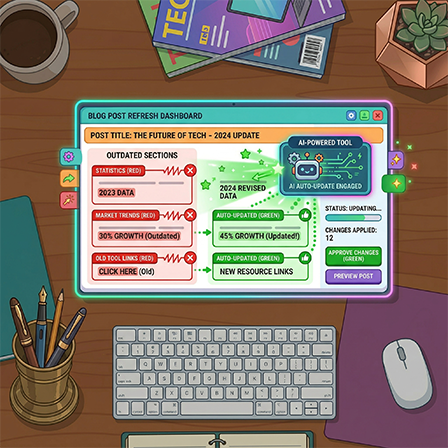
AI moves fast, and so does information. A key part of being an “Authority” is keeping your information current. Use AI to help you identify which parts of your old blog posts are outdated and refresh them with new data and insights.
Summary Table: AI vs. Google Standards
| Google Standard | AI Can Help With… | The Human Must Provide… |
| Experience | Outlining personal stories | The actual story and photos |
| Expertise | Organizing complex info | Nuance and professional opinion |
| Authoritativeness | Generating citations | The reputation and credentials |
| Trustworthiness | Checking for grammar/logic | Fact-checking and transparency |
Ready to Use AI to Meet Google Standards Safely?
Navigating the intersection of AI and SEO can feel like walking a tightrope. You want the speed of automation, but you can’t afford a Google penalty. That’s where we come in.
At Digital Consulting, we specialize in helping businesses integrate cutting-edge technology without losing the “human” element that search engines crave. Whether you need a full overhaul or just some guidance on AI Search Engine Optimization, we have the expertise to get you there.
Stop guessing and start ranking. Contact us today to see how we can level up your digital presence with Affordable SEO services Cape Town.
Frequently Asked Questions
Q: Will AI content ever rank #1?
A: Absolutely. Many AI-assisted articles rank #1 every day. The key is that they are assisted, not automated. They still provide massive value to the reader.
Q: Does Google have an AI detector?
A: Google focuses on content quality signals rather than “detecting” AI. If your content is helpful, original, and accurate, it doesn’t matter if an AI helped write it.
Q: How often should I audit my AI content?
A: At least once a quarter. AI content can “age” faster if the underlying data the AI used becomes obsolete.


