

Table of Contents
Getting your small business website onto the first page of Google in Cape Town isn’t about “quick hacks” anymore, it’s about building trust, relevance, and authority over time.
In 2026, Google’s algorithm is heavily influenced by:
- User experience
- Local relevance
- Content quality
- Trust signals (reviews, backlinks, brand mentions)
And for local businesses? It’s even more specific.
Google uses three core factors to rank local results:
- Relevance – how well you match the search
- Distance – how close you are to the searcher
- Prominence – how trusted and well-known you are
This guide breaks down exactly how to win across all three, step by step.
1. Start With a Solid SEO Foundation (Don’t Skip This)
Before anything else, your website needs to be technically sound.
Google won’t rank a site that:
- Loads slowly
- Isn’t mobile-friendly
- Has broken pages
- Is difficult to crawl
Why this matters:
User experience is now a core ranking factor, especially for mobile users, who make up the majority of local searches.
What to focus on:
- Fast load speeds (Core Web Vitals)
- Mobile-first design
- Clean site structure
- Secure HTTPS
If you’re unsure where to start, consider a professional audit.
2. Optimise Your Google Business Profile (This Is Non-Negotiable)
Your Google Business Profile (GBP) is the #1 local ranking factor.
Don’t let your competitors monopolize the neighbourhood. Get on the map or get left behind.
Optimisation checklist:
- Complete every section (services, categories, description)
- Add high-quality images
- Keep hours updated
- Post updates regularly
- Use keywords like “Cape Town + service”
A well-optimised profile increases your chances of appearing when someone searches:
- “Web designer Cape Town”
- “SEO agency near me”
3. Get More Google Reviews (This is HUGE in 2026)
Your ranking is now a reflection of your reputation. Feedback is no longer a choice; it’s the pulse of your online presence.
Google evaluates:
- Number of reviews
- Quality (positive vs negative)
- Recency
- Responses
Practical strategy:
- Ask every happy client for a review
- Send a follow-up email after a completed service
- Reply to every review (yes, even negative ones)
Pro tip: Reviews that include keywords (e.g., “best SEO company in Cape Town”) can boost visibility.
4. Target Local Keywords (Cape Town-Specific SEO)
If you’re not targeting location-based keywords, you won’t rank locally.
Examples:
- “SEO services Cape Town”
- “Web design Cape Town”
- “Affordable SEO South Africa”
Where to use them:
- Page titles
- Meta descriptions
- Headings
- URLs
- Content
Google uses these signals to determine relevance.
5. Create Location-Based Landing Pages
If you serve multiple areas around Cape Town, create separate pages for each.
Example:
- /seo-cape-town
- /seo-stellenbosch
- /seo-blouberg
Why this works:
Google prefers hyper-relevant pages tailored to specific locations.
6. Build High-Quality Content (EEAT Matters More Than Ever)
Google is prioritising Experience, Expertise, Authoritativeness, Trust (EEAT).
This means:
- No generic AI fluff
- No thin content
- No keyword stuffing
What works:
- In-depth guides (like this one)
- Case studies
- Industry insights
- Helpful blog posts
Learn about AI SEO content strategies and how it works.
7. Build Local Backlinks (Authority Boost)
Backlinks are still one of the top ranking factors.
But not all links are equal.
Focus on:
- Local directories (Brabys, Yellow Pages)
- Cape Town blogs and news sites
- Industry partnerships
- Guest posting
Why it matters:
Backlinks signal authority and trust to Google.
8. Ensure NAP Consistency Everywhere
NAP = Name, Address, Phone Number
This must be identical across all platforms:
- Website
- Google Business Profile
- Social media
- Directories
Even small inconsistencies can hurt rankings.
9. Improve Your Website’s User Experience
Google tracks how users interact with your site:
- Click-through rate
- Time on page
- Bounce rate
If users leave quickly, your rankings drop.
Improve UX by:
- Making navigation simple
- Using clear CTAs
- Improving readability
- Avoiding clutter
10. Optimise for Mobile (Most Searches Happen Here)
More than 70% of local searches happen on mobile devices.
Your site must:
- Load fast on mobile
- Be easy to navigate
- Have clickable buttons
11. Use Structured Data (Schema Markup)
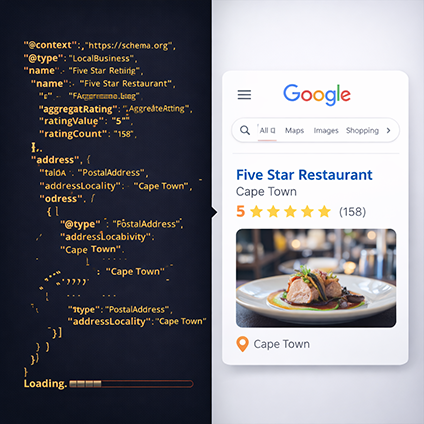
Schema helps Google understand your business better.
Add:
- LocalBusiness schema
- FAQ schema
- Review schema
This can help you:
- Appear in rich results
- Improve click-through rates
12. Publish Locally Relevant Content
Generic content won’t rank locally.
Instead, create:
- “Best [service] in Cape Town” guides
- Local case studies
- Community-related content
Why this works:
It signals local relevance and authority.
13. Keep Your Content Updated
Google prefers fresh, up-to-date content.
Strategy:
- Update old blog posts
- Add new statistics
- Refresh outdated info
- Merge articles that are on similar topics

14. Track Your SEO Performance
You can’t improve what you don’t measure.
Tools to use:
- Google Search Console
- Google Analytics
- Rank tracking tools
- Microsoft Clarity
Monitor:
- Rankings
- Traffic
- Conversions
15. Be Consistent (SEO Is a Long Game)
Here’s the truth most agencies won’t tell you: SEO takes time.
You won’t rank overnight, but if you stay consistent:
- You build authority
- You gain trust
- You outrank competitors
Bonus: Work With an SEO Agency (If You Want Faster Results)
If you want to accelerate results, working with experts can make a big difference.
We’ve been in the industry for around 10 years! We know all the ups and downs that small businesses face to get found online. Let us help you navigate your search visibility journey.
Final Thoughts: What Actually Gets a Small Business Website to Page 1?
To summarize, ranking on Google in Cape Town comes down to:
- Strong Google Business Profile
- Consistent reviews
- High-quality content
- Local relevance
- Technical SEO
- Backlinks and authority
When these work together, your chances of landing on page one increase significantly.
Want Help Ranking on Page 1?
If you’re serious about growing your business online, it might be time to take action.
Whether you’re just starting or looking to improve your rankings, having the right strategy in place makes all the difference.


